Table of Contents
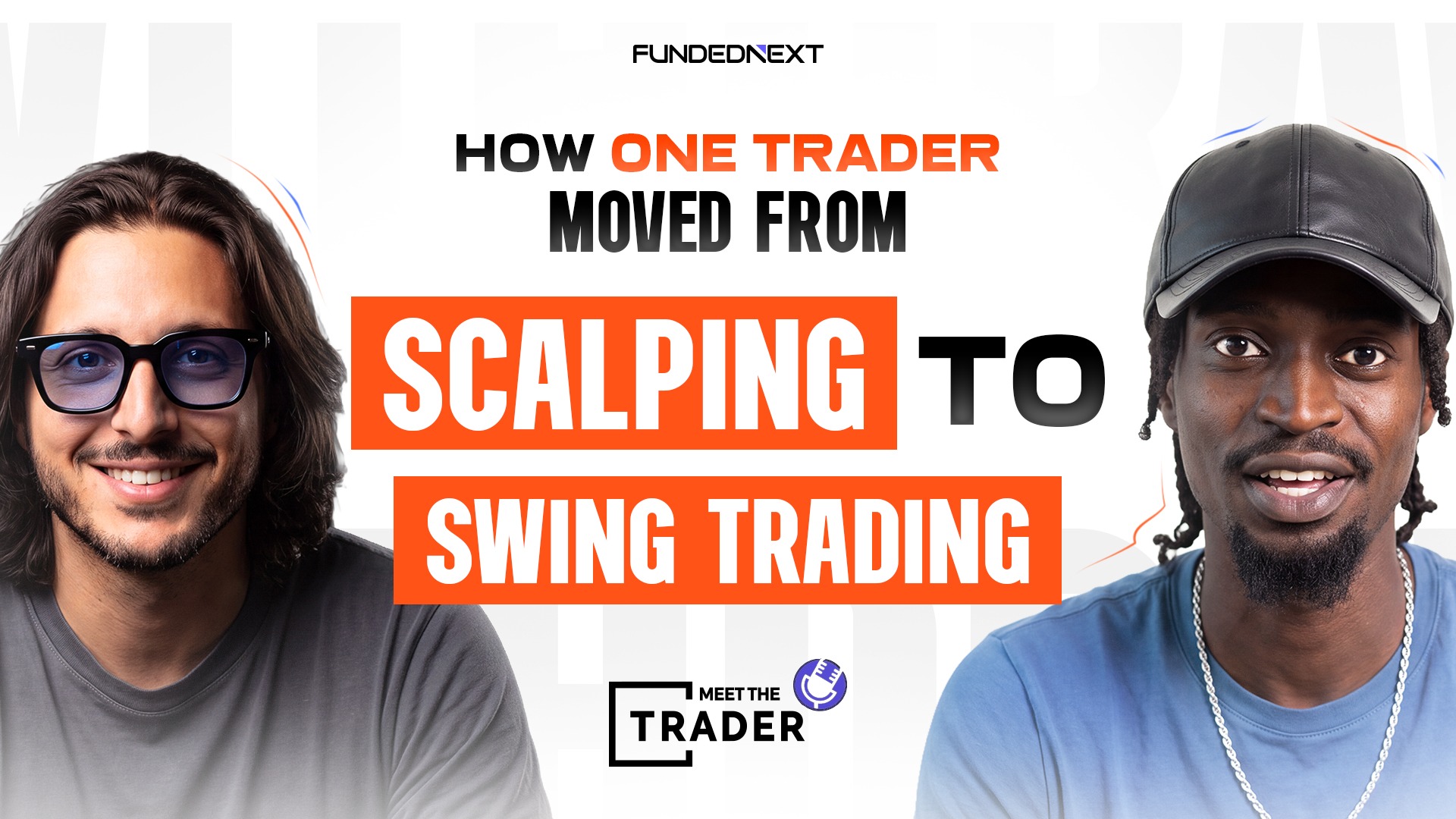
Most traders spend years copying a strategy that worked for someone else, then blame themselves when it does not work for them. Jeremiah scalped the 5-, 15- and 30-minute charts for roughly three years without finding consistency. After he moved to swing trading in February, he says his win rate rose from around 50% to 60-65%.
He shared the full story on Meet the Trader, hosted by Teammate Alex. Here is what stands out, with the numbers he gave.
How Jeremiah started trading in 2020
Jeremiah began trading in June 2020. College had moved online, he had lost his warehouse job, and a YouTube video told him forex was a skill he could learn alone. He put about $1,000 at a time into a broker account and traded gold with no plan. The losses followed.
What changed was a free daily Zoom stream. A trader broke down GBPJPY an hour before the London open, then traded it live. Seeing a setup play out in real time, not in a screenshot, convinced Jeremiah the method was real. He napped from 9 to 11 p.m. so he could join after midnight.
Why prop firm rules changed the way he traded
The same stream introduced him to prop firms. At the time, a challenge for a 100K account cost him roughly $500 to $600, instead of depositing $1,000 of his own money again and again. The rules did the rest. A 5% drawdown limit and a profit goal meant he could not, in his words, “just blow it on the first trade.”
His first payout came in 2021. He had pushed a combined 300K of capital out of a deep drawdown, then ran a 10-day winning streak that took the account to about $15,000 in profit. One losing day broke the streak, overtrading followed, and the balance slid back to around $13,000. He withdrew $2,000.
“It’s not real until you withdraw it,” he said. He called the payout bittersweet.
Three years without consistency
From 2021 to 2023, Jeremiah freestyled support and resistance breakouts on short timeframes. The results were choppy. He kept buying challenges and failing them.
Two things moved him forward. He read Trading in the Zone and turned to the mental side of the work. Then a stretch on futures taught him one fact about himself: he is not a short-term trader. “I can barely hold a five-minute trade,” he said.
A swing trader he followed showed him that swing trading can mean holding for days, not weeks. In February, Jeremiah made the switch. By his own account, the progress was immediate.
What his approach looks like now
Jeremiah described his current method as a set of fixed choices:
- Instrument: gold
- Timeframes: 4-hour and daily for direction, 1-hour for entries
- Setup: support and resistance break and retest, in line with the overall direction
- Frequency: about one trade a week
- Risk-reward: usually 1:2, sometimes 1:2.5 or 1:3 when a challenge profit target is the goal
- Management: alerts at take-profit levels, with no move to break-even at 1:1
He skips setups that only offer 1:1. He does not move to break-even because, once a trade reaches 1:1, his analysis is already playing out, and 4-hour candles are, to him, “more solid evidence” than a 5-minute chart. He sets his alerts, then steps away from the screen.
He is candid about the limits. He has not completed a year of swing trading, and he says there is room to improve on a 60-65% win rate.
Why holding time matters
Most firms close your position automatically at 5 p.m. on Friday. FundedNext does not. Your trade stays open through the weekend on an evaluation or a FundedNext Challenge account. For a trader who holds positions for days, that is the difference between a plan and a deadline.
Withdraw first, then reset
Jeremiah now trades his own capital too, and he borrowed the prop firm structure. After a winning trade, he withdraws the profit and resets the balance to the starting amount. When he wants a larger account, he deposits more, and that amount becomes the new baseline.
Two losses he still remembers
His biggest loss on paper came on a gold trade during the New York session. He was in profit when slippage carried price past his stop loss and past the 5% daily loss limit. The account closed with the profit gone.
The loss he describes as harder to shake is smaller. He sat in drawdown for a long time, closed at break-even once the trade recovered, then watched it take off.
One piece of advice
Asked what he would tell his younger self, Jeremiah said: study the psychology earlier.
He used basketball to explain it. Everyone plays the same sport, but a trader who cannot “jump out the gym” like LeBron James can still score as a spot-up shooter. “He can do it. You can do it too. But maybe just not his way.”
Check the rules before you choose a style
FundedNext publishes every rule before you pay, so you can compare a drawdown limit, a profit target and a payout schedule with how you trade. Read the full rules for each FundedNext Challenge account here.
Watch the full interview: Meet the Trader with Jeremiah